FAQs
Is Zeyora officially claiming every Saudi tenant is live on ZATCA by default?
No. The safer and more honest answer is that Zeyora supports Saudi ZATCA workflow readiness and activation steps. Production use depends on tenant setup, document types, credentials, testing and the selected environment.
What is the difference between a Saudi tax invoice and a simplified tax invoice?
A tax invoice is generally used for business-to-business transactions and must be cleared through the FATOORA platform before it is shared with the buyer. A simplified tax invoice is generally used for business-to-consumer transactions; it is generated with the required QR and then reported to ZATCA within 24 hours in the integration phase. Your document types and use case should be confirmed as part of implementation.
Does Zeyora store Saudi customer FATOORA fields?
Yes. The workflow supports Saudi-specific customer details such as commercial registration, street, district, building number, city and postal code so invoice records are cleaner before posting.
Can Zeyora show ZATCA submission status?
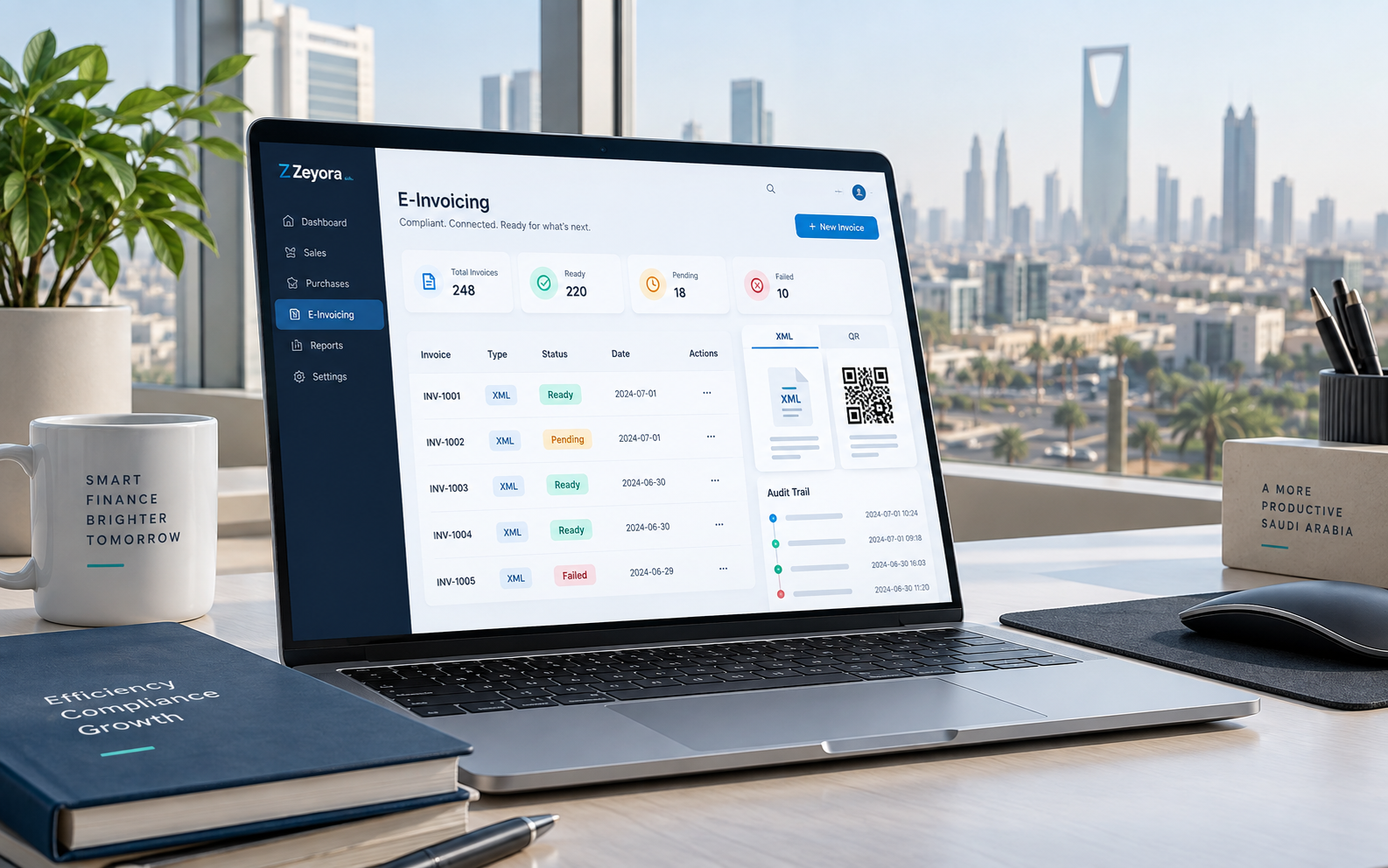
Yes. The Saudi workflow is designed around generated artifacts, clearance or reporting state, errors, retry needs and audit events so finance users can see what happened and follow up with the right owner.
What should be completed before production activation?
Confirm the business entity and VAT details, ZATCA notification and deadline, EGS units, sandbox testing, CSR and CSID onboarding, document templates, customer data, retry ownership and finance approval. Production activation should follow the tenant's document types, credentials and ZATCA requirements.
Is Zeyora responsible for a customer's statutory compliance?
Zeyora can support the business workflow and implementation preparation, but each customer remains responsible for its tax registration, ZATCA notification, document classification, testing, production activation and ongoing statutory compliance.